
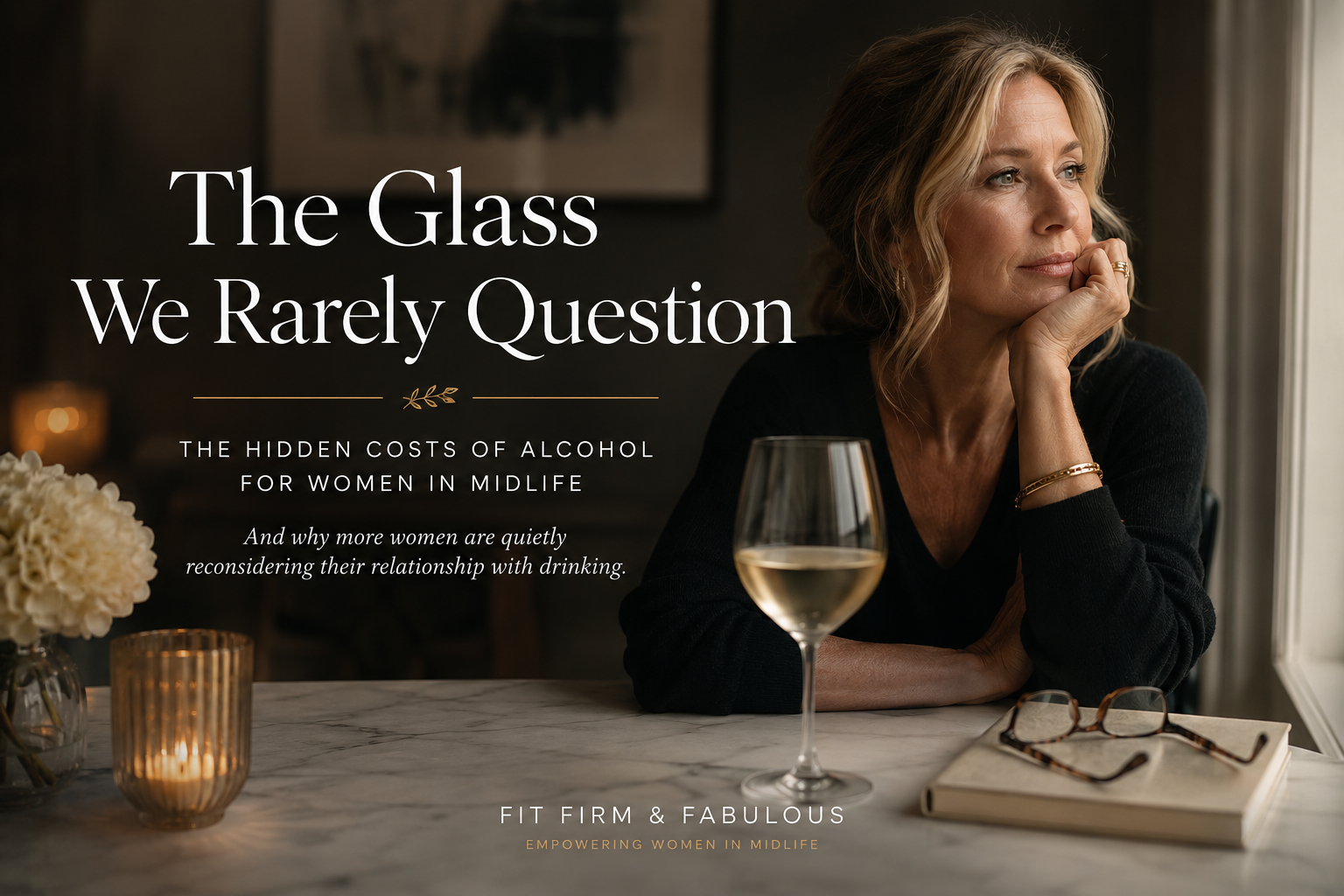
The Hidden Costs of Alcohol for Women in Midlife
A few years ago, a woman I know stopped drinking during the week.
It was not a dramatic decision. Nothing had gone catastrophically wrong. Her life looked steady from the outside: work, relationships, routines, responsibilities all in place. But she was tired of waking up as if she had borrowed energy from tomorrow.
At first, she thought she would miss the wine. What she missed most was the ritual around it: the pour, the pause, the moment the evening seemed to shift from obligation to privacy. When she removed the drink, she saw how much it had been doing as a cue, not just a beverage.
That is the quiet power of alcohol in many women’s lives. It is often less about taste than timing. It arrives when the day is over but the mind is not, when work is finished but the body still feels on call, when life is quiet enough to notice how much has been carried.
The Ritual Hidden Inside the Glass
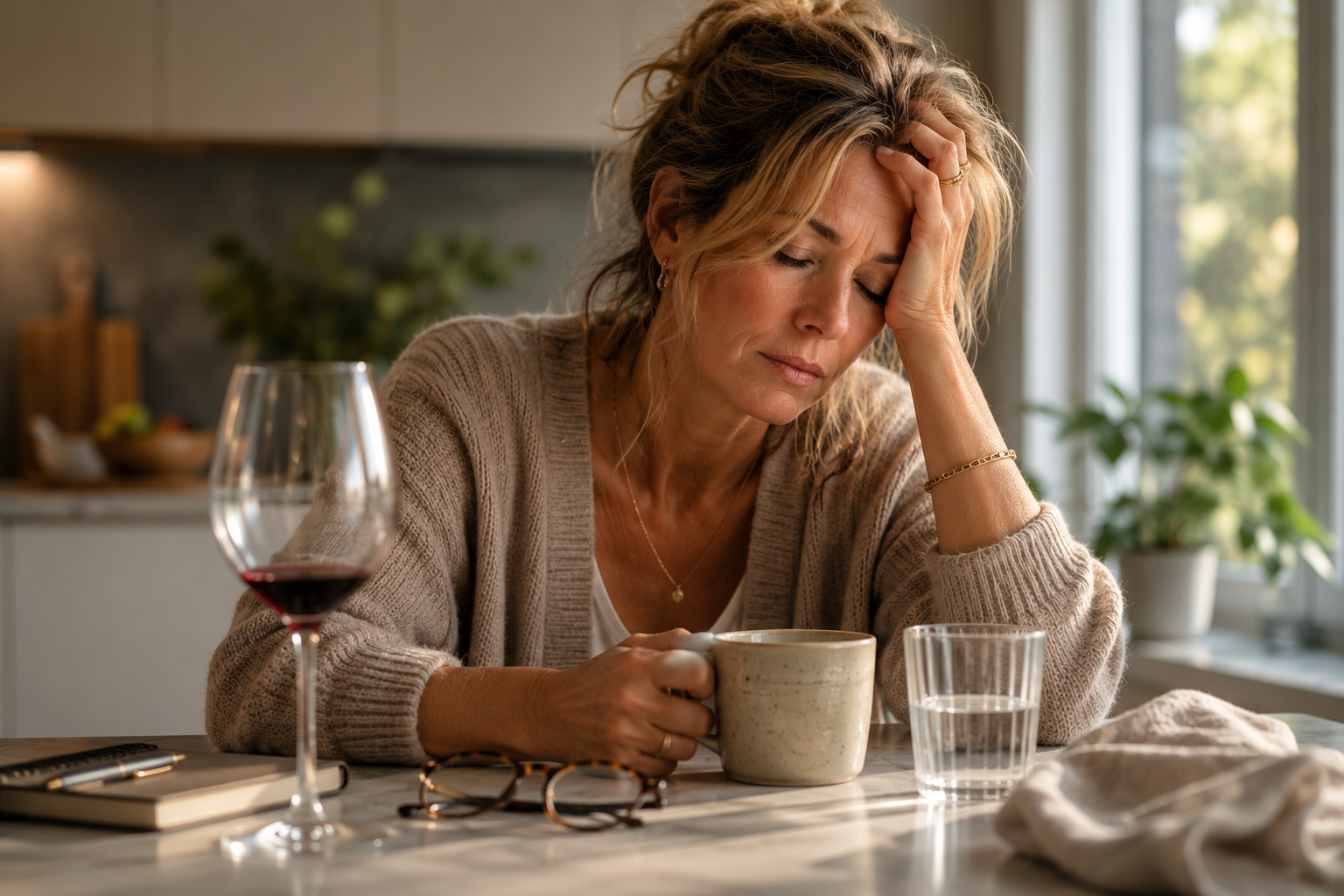 By midlife, many women have become experts at appearing fine. They move through fatigue, stay pleasant when irritated, and manage the practical details of life without asking for much in return. Their lives may be full, meaningful, and exhausting all at once. Nothing looks bad enough to justify complaint, so the evening drink slips in as punctuation.
A glass of wine while cooking. A cocktail at dinner. Something poured at the end of a long week. Alcohol is often treated as celebration, reward, or relief — and sometimes all three at once. That is part of why it goes unexamined for so long.
Many women question nearly everything else before they question the glass. They change their diets, buy supplements, track sleep, adjust workouts, and try to understand why fatigue, cravings, mood swings, and slower recovery seem more noticeable with age. Alcohol often stays protected by the idea that they deserve it.
That question is fair. Women do deserve pleasure, beauty, rest, and a life with small luxuries. The more useful question is not whether they deserve the drink, but whether it is actually giving them what they hope it will.
For more and more women, the answer is becoming harder to ignore. The signs are usually small: a restless night after two glasses, a heavier morning than expected, a familiar promise to reset on Monday. Nothing dramatic. Just enough to suggest that what once felt harmless may no longer be neutral.
The old language around alcohol leaves little room for that middle ground. For years, drinking was discussed in extremes: problem or not problem, control or chaos. But many women live in the gray area — intact lives, growing discomfort. They are not necessarily trying to quit forever. They are simply noticing that alcohol sometimes leaves them less rested, less clear, and less connected to themselves.
That noticing matters. The glass is rarely the whole story. More often, it is where a deeper story becomes visible: a woman trying to come down from the demands of her own life, and slowly realizing that what helps her feel less for a little while may also be keeping her from feeling better in the long run.
Alcohol did not become part of women’s self-care culture by accident. It entered through the language of reward. The long week deserved wine. The stressful meeting called for a cocktail. The vacation began with something sparkling. The girls’ weekend was built around it, even when no one called it self-care out loud.
Culturally, alcohol has occupied the emotional space meant for rest, pleasure, and release. It softens the day, marks a transition, and makes ordinary moments feel more ceremonial. Much of its appeal comes from the way it gives women permission to step out of usefulness, if only for an hour.
That matters because modern self-care is full of contradiction. Women are told to rest, but only efficiently. To prioritize themselves, but not too much. To create balance in lives that may not be built for balance at all. In that context, a ritual with immediate effect can feel less like indulgence than relief.
A woman who spends her day answering messages, managing schedules, caring for others, and holding everything together may not be reaching for alcohol. She may simply be reaching for a signal that the demands have paused. A drink becomes a bridge from obligation into ease.
Without that bridge, the day bleeds into the evening. Work ends, but the mind keeps moving. Dinner happens, but planning continues. The body sits down while attention stays alert. Alcohol offers a clean dividing line, a small ceremony that says the day is over even when nothing else has changed.
Rituals are powerful because they disappear into the background. Morning coffee, evening news, a walk after dinner, a glass of wine while cooking: they stop feeling like choices and start feeling like the shape of life itself. That is why many women only begin reexamining alcohol when they realize their questions are really about something larger — how they recover, how they rest, and why genuine ease feels so hard to access.
The Weight of Constant Attention
 One of the least discussed burdens of adulthood is attention. Not effort, which is visible, but attention: the mental work of keeping track of everything while life keeps happening. A woman can be driving, working, folding laundry, or having dinner with friends and still be carrying a running list in her head.
That invisible effort is exhausting precisely because it looks like nothing from the outside. Modern life rewards it. Women who are prepared, responsive, organized, and dependable are praised for their capacity. They become the ones people trust. But admiration is not the same as relief.
A capable woman can become trapped inside the competence that makes her valuable. Because she functions well, her fatigue is easy to miss. Because she rarely falls apart, people assume she is fine. After a while, even she may stop noticing how much effort it takes to stay that composed.
By evening, what she may crave is not excitement but a suspension of effort: less tracking, less anticipating, less solving. Alcohol can seem to offer that quickly. It softens the edges of constant awareness and creates a little distance from the day. But temporary spaciousness is not recovery.
In midlife, that distinction becomes harder to ignore. The body becomes less willing to cooperate with illusions. Sleep is more sensitive. Energy is harder to rebuild. Mood shifts are more noticeable. Habits that once seemed consequence-free begin leaving receipts.
The question, then, is not only what alcohol does to the body. It is why so many women feel they need to soften their lives just to make them bearable by evening.
Exhaustion rarely announces itself. It settles into ordinary life until it is hard to separate from routine. A woman who once felt energetic starts describing herself as tired. Plans feel heavier. Patience shortens. Recovery takes longer. Nothing seems severe enough to call an emergency, but something has changed.
From the outside, her life may still look impressively intact. She answers messages, shows up, handles logistics, and remembers the details that keep everything moving. Her calendar may look full but normal. That is the problem with accumulation: it rarely looks like a crisis.
Responsibilities gather slowly — work, family, aging parents, changing bodies, friendships, homes, health. Women adapt well, often too well. They become efficient because they have to be. They function while tired. They stay composed while concerned. They keep going while hoping for a break that never quite comes.
In that context, a nightly drink can start to mean more than it appears to. It marks a boundary between the self the day required and the self allowed afterward. That ritual is human. People need ways to mark endings. Without them, life can feel like one long stretch of demand.
The question is whether the ritual still fits. For some women, it does. For others, the next morning begins to feel heavier: sleep is less restorative, the mind less clear, the body slower. Not a dramatic hangover, just a small deficit that repeats often enough to matter.
A woman may blame stress, age, or a busy week. Often it is all three. But patterns become visible when she pays attention. She skips the weeknight glass and notices cleaner mornings. She wakes with less friction. Energy is steadier. The difference may be subtle, but repeated over time, subtle becomes significant.
Alcohol and sleep are especially intertwined. It may make falling asleep easier, but rest is often lighter and more fragmented later in the night. The result is not always obvious exhaustion. More often it shows up as reduced capacity: a shorter temper, stronger cravings, less interest in movement, a vague sense of being behind before the day has begun.
Those effects are easy to explain away, but they add up. And because women are often expected to keep functioning no matter how they feel, many simply compensate. They drink more coffee, push through workouts, delay rest, and promise themselves they will reset. That cycle can make progress feel slippery: strong start, gradual unraveling, quiet disappointment, repeat.
This is where alcohol becomes less a moral issue than a practical one. The question is not whether one drink ruins anything. It is whether the habit repeatedly borrows from tomorrow and leaves a woman trying to catch up with herself.
What the Next Morning Reveals
 What alcohol quietly takes away is not always obvious in the moment. It can erode morning clarity, emotional steadiness, patience, follow-through, deep sleep, and self-trust. A woman may not notice one night or one weekend. But over time, she may begin to feel less like herself: more foggy, less present, more dependent on recovery than she wants to be.
That loss is not only physical. It is relational. Every time a woman explains away what she already knows, she weakens her trust in herself a little. Every time she honors that inner clarity, even imperfectly, something steadier returns.
That is one of the quiet surprises of drinking less. The obvious benefits may be better sleep or more energy. But the deeper shift is often emotional: women begin to feel less interrupted by sluggish mornings, less interrupted by anxiety, less interrupted by the sense that they are always starting over.
When Reward Starts to Blur with Relief
Drinking less is not always about sobriety as identity. For many women, it is about choice. They are no longer letting alcohol occupy a place by default. They are asking whether it still fits the life they are trying to create now — not years ago, not in a different season, but now.
That question can reshape everything. A woman may discover she misses connection, not cocktails; rest, not reward; pleasure, not escape. She may realize she is not rejecting enjoyment, only refusing to confuse it with anesthesia.
Perhaps alcohol is not the problem for every woman who reconsiders it. Perhaps it is a clue: to deeper rest, clearer boundaries, stronger support, better sleep, or a life that does not require so much softening at the edges.
The real question may never have been, “Should I drink less?”
What Women Are Really Thirsty For
It may have been, “What am I truly thirsty for?”
Sometimes the answer is not a dramatic reinvention. It is quieter than that. It may look like sitting down before the evening has fully disappeared into tasks. It may look like eating dinner without also answering messages, or letting the kitchen stay imperfect, or noticing that a small pause can feel more sustaining than the usual pour. What women may be thirsty for is not intensity, but relief that does not ask to be paid back later.
That distinction matters because alcohol can imitate comfort so convincingly. It can feel warm, social, softening, familiar. It can seem to offer permission without requiring explanation. But the body knows the difference between being soothed and being dulled, even when the mind prefers not to. A drink may quiet the edges of the day, but it does not always restore what was frayed inside it. Real nourishment is often less flashy and more lasting. It leaves a different kind of trace.
For many women, the deeper longing is not only for rest in the physical sense, but for rest from noticing everything. Rest from checking whether they have done enough, said enough, anticipated enough. Rest from the habit of monitoring their own moods, their own appetites, their own usefulness. The evening drink can become a place where surveillance briefly loosens. Yet what if the real relief lies in not needing to perform that loosening at all?
That is where the question becomes tender. A woman may realize she is not reaching for the drink itself so much as for the moment when she is finally allowed to stop being on. The ritual has carried the weight of a transition, but perhaps the transition she wants is not into numbness. Perhaps it is into being unmeasured for a while. Into a quieter room. Into a less defended version of the self.
Connection can live here too, in its many forms. Not the bright, social kind that requires energy and polish, but the simple feeling of being known without having to entertain. A conversation that does not need to be impressive. A partner who notices the heaviness before the glass appears. A friend who can sit in the ordinary end of the day without trying to fix it. Sometimes the thing standing across from the drink is not abstinence, but companionship — a reminder that ease does not have to be solitary.
There is also something to be said for smaller evenings, for lives that are not endlessly expanded by obligation. A woman who no longer wants to soften the edges of her nights may be discovering that the problem was never only the drink. It was the accumulation around it: the pace, the pressure, the invisible demand to remain accessible even when she was tired. Once that becomes visible, the ritual starts to look less like a habit and more like a signal.
And signals can be listened to. They can point toward what has been missing all along: enough sleep, enough silence, enough unstructured time, enough permission to be ordinary. Not every woman will change her drinking, and not every drink will feel false. But the ones who begin to notice what feels nourishing versus what merely numbs often find that the distinction changes more than they expected. The evening still arrives. The life still asks things of them. But the relationship to the ritual shifts, because the ritual is no longer carrying an unspoken job it was never built to do.
In that sense, the real movement is not from weakness to virtue. It is from confusion to clarity. From using a glass to blur the edges of need to recognizing the need itself with more honesty. That recognition may not end with a firm decision or a clean break. Often it begins much more modestly: with one less automatic pour, one more honest pause, one clearer sense of what the body is asking for in place of the drink.
What am I truly thirsty for? Perhaps the answer is not less life, but less strain. Not less pleasure, but less performance. Not another way to disappear from the evening, but a way to inhabit it without apology. And when that becomes clearer, the glass is no longer the center of the story. It becomes only one object in a larger, more human search for comfort that can actually hold.