

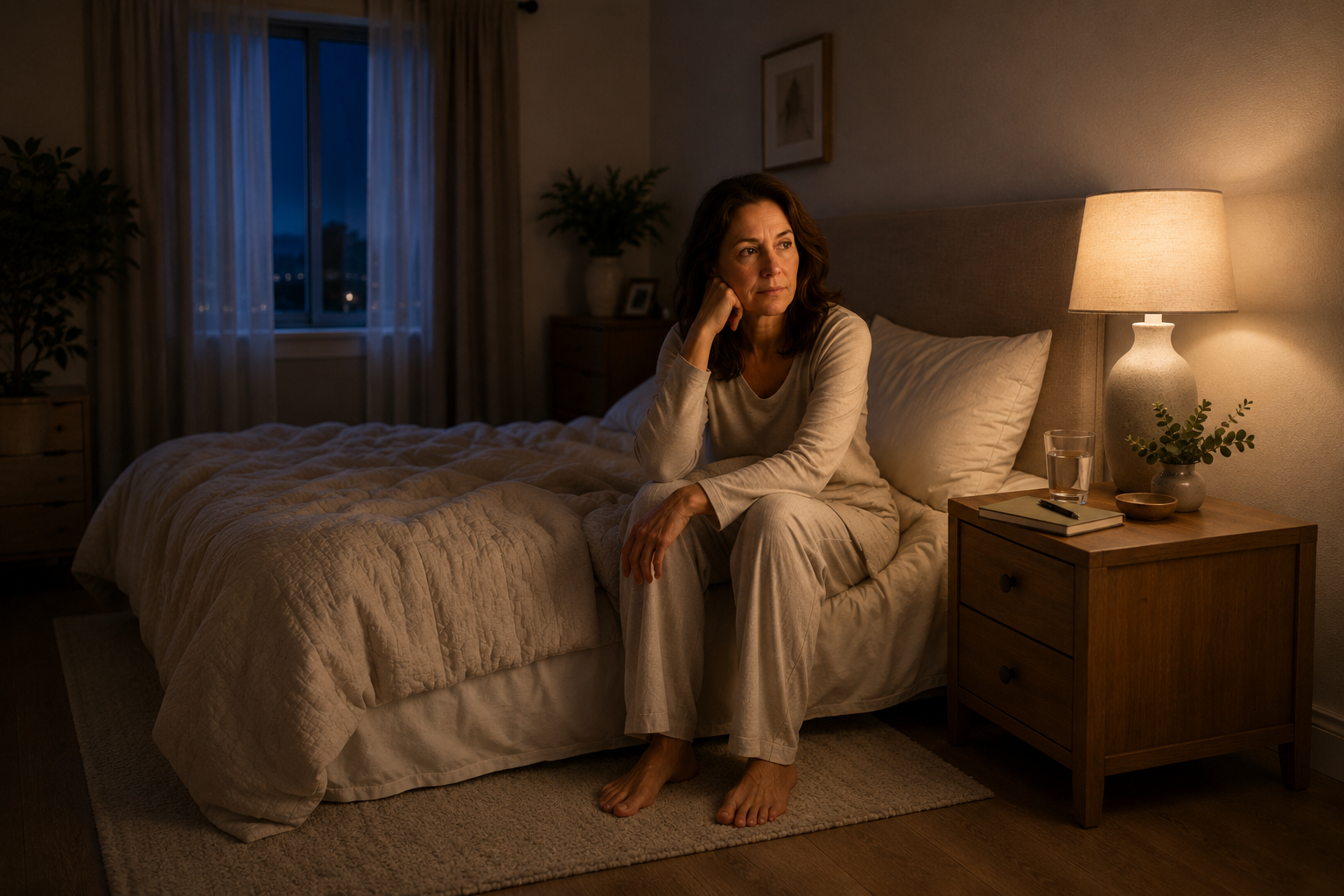
You know the wake-up. It’s somewhere between 2 and 4 a.m. — often exactly 3:12, or close enough that it stops feeling like coincidence. You’re wide awake, heart sometimes racing, mind moving immediately into the anxious loop that seems to have been waiting for you. You lie there hoping it will pass. Sometimes it does. Often it doesn’t. By the time morning arrives you’ve been awake for two hours in the middle of the night and the day ahead already feels like a negotiation.
If this is your current reality, two things are worth saying plainly. First: you’re not imagining it, and it’s not stress or anxiety in the ordinary sense, though those things are real too. Second: it has a specific physiological explanation, and that explanation points toward specific responses that actually help — rather than the generic sleep hygiene advice that’s useful in theory and insufficient in practice for what’s actually happening during this transition.
Sleep disruption is one of the most consistently reported and most significantly underestimated symptoms of perimenopause and menopause. Studies find that 40-60% of women experience significant sleep disruption during this transition — and that the disruption affects not just how rested they feel but cognitive function, emotional regulation, metabolic health, cardiovascular health, and immune function. Sleep is not a passive state. It’s when the brain consolidates memories, the body repairs tissue, hormones regulate, and the immune system does essential maintenance work. When sleep is consistently disrupted, the downstream effects touch every system.
Why This Happens: Three Overlapping Mechanisms

Sleep disruption during perimenopause and menopause has three overlapping causes, and understanding each one helps explain both why the disruption follows the specific pattern it does and why different interventions address different parts of the problem.
Mechanism 1 — Progesterone Decline
Progesterone has a natural sedating effect — it supports the production of GABA, the brain’s primary inhibitory neurotransmitter, which promotes calm and supports sleep. As progesterone declines during perimenopause, this calming influence diminishes. The same woman who slept deeply through her thirties may find in her forties that her sleep has become lighter, that she wakes more easily at noises or temperature changes that previously wouldn’t have registered, and that the restorative deep sleep stages — the slow-wave sleep that’s most critical for physical restoration — are shorter and less reliably reached.
A 2020 study published in the journal Sleep found that women in late perimenopause had significantly reduced slow-wave sleep compared to premenopausal women, independent of other factors. This reduction in deep sleep explains much of the “I slept eight hours but don’t feel rested” experience that many women in this transition describe. The quantity of sleep may be adequate but the quality — the architecture of sleep stages — has changed.
Mechanism 2 — Temperature Dysregulation
The same hypothalamic disruption that triggers hot flashes during the day creates night sweats during sleep. The hypothalamus — the brain’s temperature regulation center — responds to estrogen fluctuations with exaggerated temperature responses. A slight rise in core body temperature that would previously have been ignored now triggers a heat-dissipation response: blood vessels dilate, sweating begins, heart rate increases. This is useful biology in an environment where the threat is genuine heat. In a cool bedroom at 3 a.m. it’s disruptive biology that fragments sleep.
The temperature dysregulation mechanism explains why the wake-up so often involves a surge of heat, sometimes followed by chills as the sweating cools the body past its target temperature. It also explains why the middle of the night is particularly vulnerable — core body temperature naturally rises slightly in the early morning hours as part of the circadian rhythm, and this natural rise can be enough to trigger the hypothalamic response.
Mechanism 3 — Cortisol Timing
The body’s natural cortisol rhythm rises steeply in the first hour or two after waking to provide alertness and energy for the day ahead. During perimenopause, this cortisol awakening response can shift earlier than intended — arriving at 3 or 4 a.m. rather than closer to the natural wake time. This early cortisol surge brings with it the alertness it’s designed to produce — which is why the middle-of-the-night wake so often comes with a feeling of being wide awake rather than groggy, and why the anxious thinking that follows feels so immediate and so difficult to quiet.
Research published in Psychoneuroendocrinology has found that perimenopausal women show altered HPA axis function — the system that governs cortisol production — compared to premenopausal women. This altered function is directly connected to the early cortisol awakening pattern and the sleep fragmentation it produces.
The Anxious Spiral That Makes It Worse
Here’s something worth understanding specifically about the middle-of-the-night wake: the anxious, looping thinking that follows it is not simply a feature of your psychological state. It’s a physiological response to the cortisol surge and the temperature disruption — the brain under cortisol is more alert, more threat-sensitive, and less able to engage the prefrontal cortex functions that normally help quiet anxious thoughts.
This is important because it means there are two distinct things to address: the underlying physiological triggers — temperature, cortisol, progesterone — and the anxious response that the disruption produces. Addressing only the anxiety without addressing the physiology provides partial relief at best.
Cognitive Behavioral Therapy for Insomnia, known as CBT-I, has one of the strongest evidence bases of any sleep intervention and is particularly effective for the anxiety-around-sleep component. It teaches specific techniques for managing the mental activation that accompanies sleep disruption without worsening it. CBT-I is available through therapists, several validated apps, and structured online programs.
What Actually Helps: The Highest-Leverage Changes
Temperature Management
The temperature piece is the most immediately actionable starting point for most women. The bedroom should be cool — research consistently finds 65-68°F as the optimal sleep temperature, and perimenopausal women often benefit from the lower end of that range or cooler. A ceiling fan or portable fan serves double duty — lowering ambient temperature and providing white noise that reduces the impact of incidental sounds on already lighter sleep.
Breathable, moisture-wicking bedding matters more than most women realize. Cotton sheets breathe significantly better than synthetic fabrics. Bamboo and Tencel are particularly good options for women experiencing night sweats, as both wick moisture effectively and dry quickly. The cooling mattress pad market has expanded significantly in recent years — products like ChiliSleep allow precise temperature control throughout the night.
Layering rather than a single heavy duvet allows rapid temperature adjustment without fully waking — a light sheet plus a heavier blanket that can be easily pushed off and pulled back gives more control than a single layer that’s either too hot or too cold.
Caffeine and Alcohol Timing
Caffeine has a half-life of five to seven hours in most people — meaning a 3 p.m. coffee still has roughly half its caffeine active at 8 or 9 p.m. For women in perimenopause whose sleep is already more fragile, moving the last caffeine to before noon is the specific, research-supported recommendation. This is a significant change for many women but one of the most impactful available.
Alcohol deserves direct mention because it’s commonly used as a sleep aid and consistently worsens sleep quality in exactly the ways that matter most during this transition. Alcohol does reduce the time to fall asleep. But it fragments sleep architecture in the second half of the night, suppresses REM sleep, and worsens night sweats by dilating blood vessels and raising core body temperature. For women experiencing sleep disruption during perimenopause, alcohol is specifically counterproductive.
Morning Light and Circadian Anchoring
Natural light exposure within the first thirty to sixty minutes of waking is one of the most powerful circadian rhythm regulators available. Morning light suppresses residual melatonin, anchors the cortisol awakening response to the appropriate time, and sets the circadian clock in ways that support better sleep the following night. Even five to ten minutes outside — or near a bright window on cloudy days — produces measurable circadian effects.
Consistent Sleep and Wake Times
The single most powerful behavioral intervention for sleep is maintaining consistent sleep and wake times seven days a week — including weekends. The body’s circadian rhythm is anchored by consistent timing, and variation in sleep schedule — staying up late and sleeping in on weekends, for example — effectively creates mild social jet lag that destabilizes sleep across the entire week. For women whose sleep is already fragile due to perimenopausal changes, schedule consistency provides the strongest possible circadian foundation.
Sleep Environment Beyond Temperature
While temperature is the highest-leverage environmental factor, a few additional bedroom elements consistently affect sleep quality for women in this transition.
Consistent noise, even at low levels, can fragment sleep architecture without fully waking a person — producing lighter, less restorative sleep without a clear sense of why. White noise, pink noise, or brown noise played consistently throughout the night masks the variable sounds that interrupt sleep.
Light exposure during sleep — including the blue light from phone screens and the ambient light from streetlights or electronics — suppresses melatonin production and reduces sleep depth. Blackout curtains or a sleep mask address ambient light. The phone specifically deserves attention — the combination of blue light exposure, notification sounds, and the psychological activation of checking messages is consistently sleep-disruptive. Charging the phone outside the bedroom removes the temptation entirely.
When the Disruption Warrants a Medical Conversation

Sleep disruption severe enough to significantly affect daytime functioning — concentration, mood, safety when driving, overall wellbeing — warrants a conversation with a doctor rather than lifestyle management alone.
Hormone therapy addresses the underlying hormonal causes of sleep disruption — progesterone decline, estrogen fluctuation, temperature dysregulation — rather than just the symptoms. For women with significant sleep disruption during perimenopause, hormone therapy is often one of the most effective interventions available.
Sleep apnea deserves specific mention because its risk increases after menopause, and its symptoms overlap significantly with perimenopausal sleep disruption. Waking frequently, poor sleep quality despite adequate time in bed, daytime fatigue, and partner reports of snoring or breathing pauses are all worth discussing with a doctor.
Low-dose melatonin — 0.5mg to 3mg — taken thirty to sixty minutes before the intended sleep time has a meaningful evidence base for improving sleep onset and supporting circadian alignment during menopause. It is most effective for the falling asleep problem rather than the staying asleep problem, and works best when combined with consistent sleep timing and morning light exposure.
Common Questions About Sleep During This Transition
Is it normal to need less sleep during perimenopause?
Most women don’t actually need less sleep — they’re getting less because the disruption reduces total sleep time. The need for 7-9 hours doesn’t change significantly during this transition. What changes is the ability to achieve it without disruption. Accepting reduced sleep as “just what happens now” rather than addressing the underlying causes means accepting avoidable consequences for cognitive function, mood, and long-term wellbeing.
Will the sleep disruption get better after menopause?
For many women, sleep does improve after the hormonal fluctuation of perimenopause stabilizes into the lower but more consistent hormonal environment of post-menopause. But “after menopause” can mean years after the transition period, and waiting without addressing the disruption means years of compromised sleep quality. The habits and interventions described in this article remain relevant throughout the transition.
Can I take sleep medications during perimenopause?
This is a conversation for your doctor rather than a general recommendation. Most pharmaceutical sleep aids address the sleep-onset problem rather than the sleep-maintenance problem that’s more characteristic of perimenopausal disruption. CBT-I has stronger evidence for long-term sleep improvement than pharmaceutical aids and doesn’t carry dependency or tolerance risks. Hormone therapy, for women who are appropriate candidates, often addresses the underlying causes more directly than symptom-focused sleep aids.
What about magnesium for sleep?
Magnesium glycinate or magnesium threonate taken 30-60 minutes before bed has meaningful evidence for improving sleep quality, particularly for the sleep maintenance problems that characterize perimenopausal disruption. Magnesium supports GABA function — the same calming pathway that progesterone supports — and has a favorable safety profile at doses of 200-400mg. It’s not a complete solution but it’s a worthwhile addition to the sleep support toolkit, particularly for women whose progesterone decline has left them with heightened nighttime anxiety and lighter sleep.
The Role of Resistance Training in Sleep Quality
Resistance training — lifting weights, bodyweight exercises, resistance band work — has a specific and often overlooked relationship to sleep quality during perimenopause. Beyond its well-established benefits for muscle maintenance, bone density, and metabolic health, resistance training influences sleep through its effects on growth hormone secretion and body temperature regulation.
Growth hormone is released primarily during slow-wave sleep — the deepest stage of sleep that’s most reduced during perimenopause. Resistance training stimulates growth hormone production, which may support the slow-wave sleep stages that are most affected by progesterone decline. Several studies have found that regular resistance training improves sleep quality in midlife women independent of its effects on hot flashes or other perimenopausal symptoms.
The timing of resistance training matters for sleep specifically. Training earlier in the day — morning or early afternoon — tends to produce better sleep outcomes than training in the evening, when the body temperature elevation that follows exercise can interfere with the temperature drop that supports sleep onset. For women who can only train in the evening, finishing at least three hours before bedtime minimizes this effect.
Digital Tools That Support Better Sleep
Several evidence-based digital tools have been specifically validated for sleep improvement during menopause and are worth knowing about.
Sleepio is a CBT-I program delivered through a digital app that has been validated in multiple clinical trials and found effective for insomnia including menopause-related sleep disruption. It’s available by subscription and is increasingly being offered through health insurance plans in the US and UK.
Oura Ring and similar wearable sleep trackers provide data on sleep stages, heart rate variability, and temperature that can help identify patterns in sleep disruption that are otherwise invisible without monitoring. Seeing that night sweats correlate with specific sleep stage disruptions, for example, makes the connection between temperature management and sleep quality concrete and actionable.
Headspace, Calm, and Insight Timer all offer specific sleep programs that include body scan meditations, sleep stories, and breathing exercises designed to reduce the anxious activation that accompanies middle-of-the-night waking. These are most useful as tools for the cognitive and emotional component of sleep disruption rather than the physiological component, and they work best alongside rather than instead of the environmental and lifestyle interventions described earlier.