

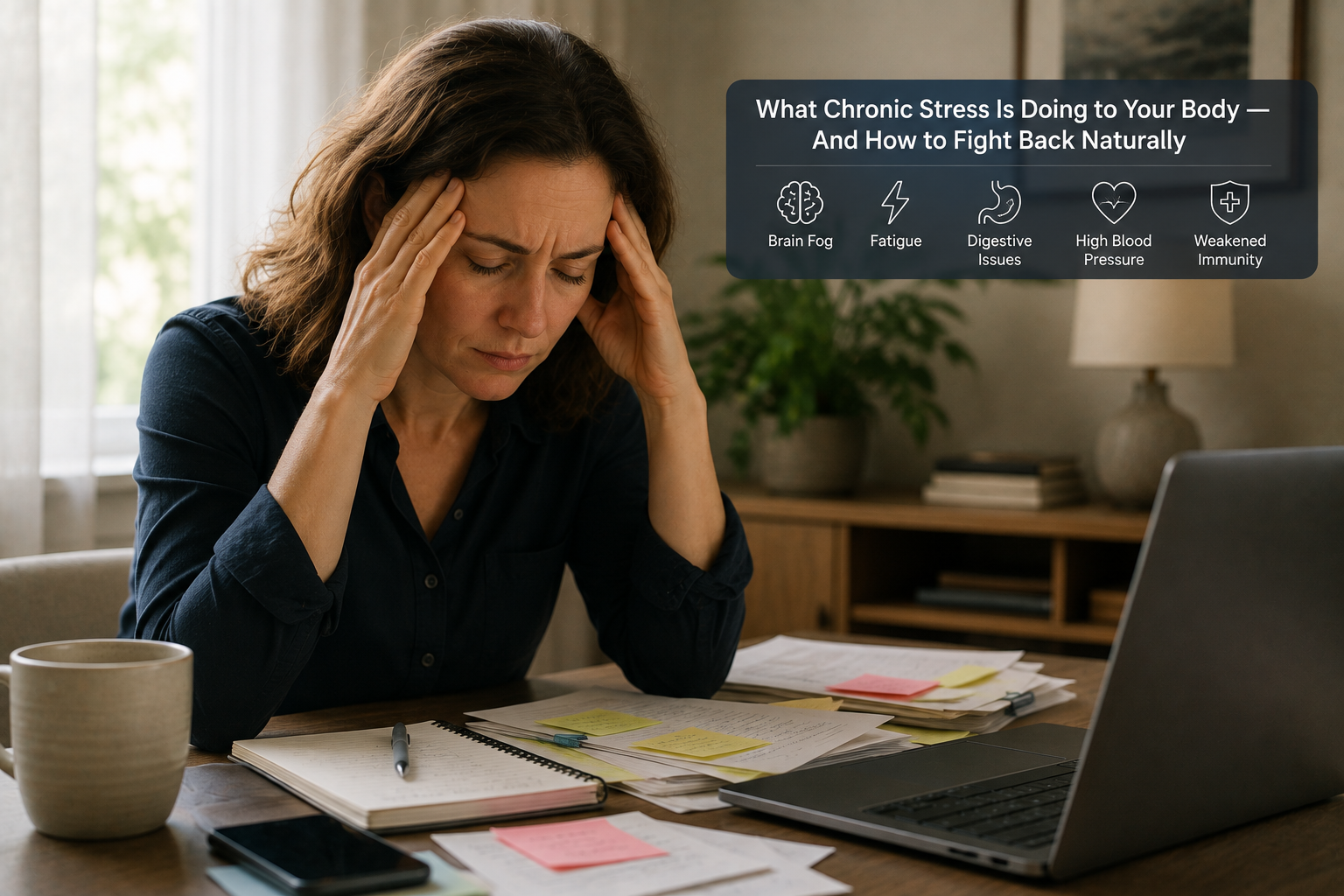
Stress has become so woven into the fabric of most women’s lives that it has stopped registering as a condition and started feeling like a personality trait. You don’t have stress. You are stressed. It is the baseline from which you operate — the hum beneath everything, the ambient state of a life that asks more than it gives back.
And because it’s constant, it becomes invisible. You stop noticing the tension in your shoulders until someone touches them. You stop registering the tightness in your chest until a quiet moment makes the contrast impossible to ignore. You stop recognizing that the irritability, the brain fog, the stubborn weight around your middle, the sleep that doesn’t restore, the skin that won’t cooperate, and the immune system that seems to fail at exactly the wrong moments are not separate, unrelated problems. They are one problem. And its name is cortisol.
This is the article that makes that connection explicit — that traces the thread from the chronic stress of your daily life through the specific physiological mechanisms by which it is affecting your body, and then gives you the real, evidence-based tools to interrupt that cascade and build genuine resilience from the inside out.
What Stress Actually Is — The Physiology
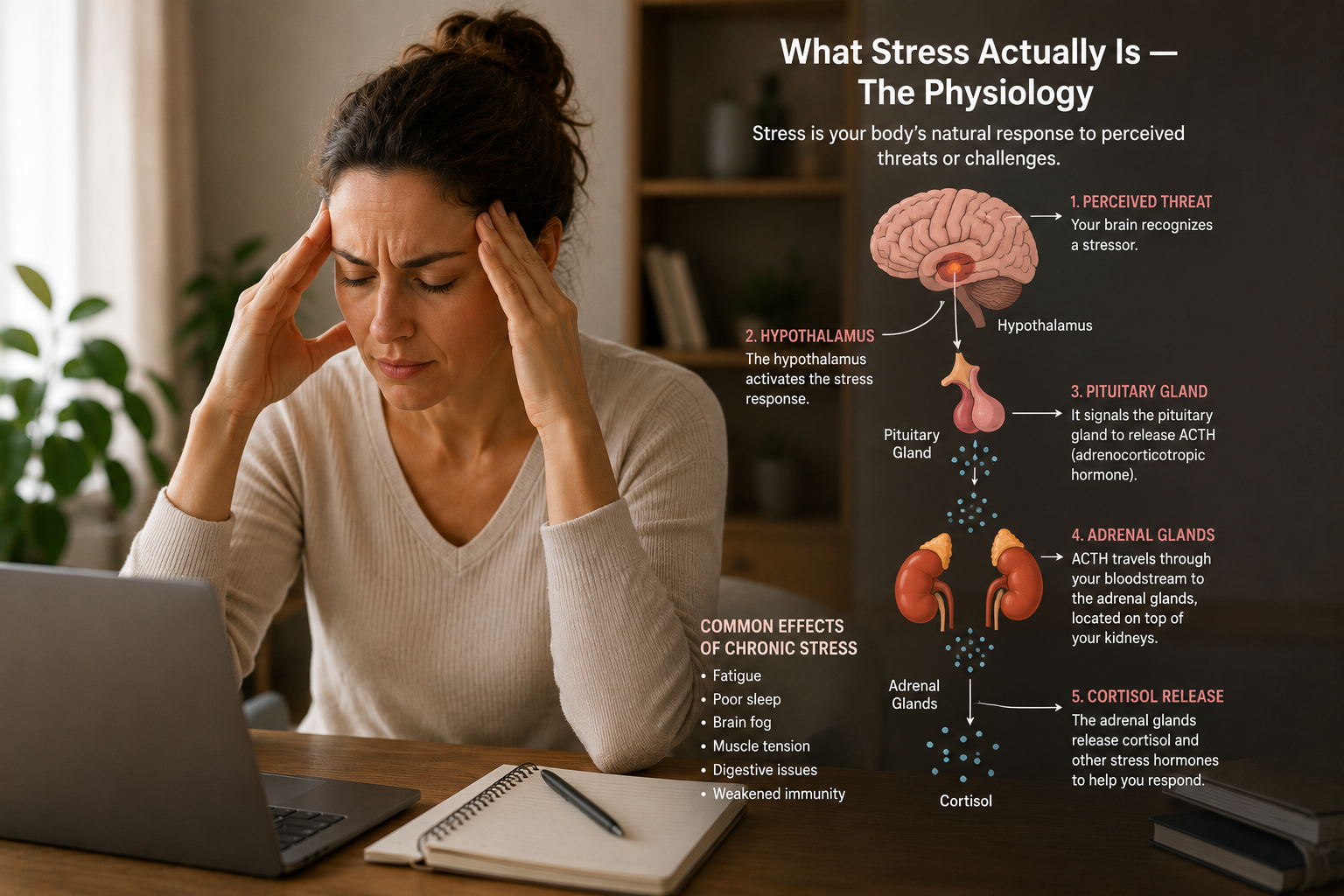
Stress is not simply a feeling of overwhelm or pressure, though those feelings are real and significant. Stress is a physiological state — a coordinated, whole-body response to a perceived threat that mobilizes every system in the body to either fight or flee that threat.
The stress response cascade begins in the brain. The amygdala — the brain’s threat detection center — perceives a stressor and sends an alarm signal to the hypothalamus, which activates the sympathetic nervous system. Within seconds, adrenaline is released from the adrenal glands, raising heart rate, elevating blood pressure, dilatin the pupils, directing blood flow toward the muscles and away from the digestive system, and flooding the bloodstream with glucose to fuel the anticipated physical response.
Simultaneously, the hypothalamic-pituitary-adrenal axis activates — a slower hormonal cascade that results in cortisol being released from the adrenal cortex within minutes to hours of the initial stressor. Cortisol sustains the stress response over a longer time frame — maintaining elevated blood sugar, suppressing immune function to divert resources toward immediate survival, increasing inflammation to prepare for potential injury, and keeping the nervous system in a state of alert activation.
This entire response is brilliant — when the stressor is a genuine physical threat and the response can be resolved through physical action. The problem is that the human stress response system cannot distinguish between a physical threat and a psychological one. An email from a difficult client activates the same cascade as a physical danger. A traffic jam triggers the same cortisol release as a genuine emergency. The body prepares to fight or flee from the argument with your partner, the overdue deadline, the child who won’t stop crying — and none of those threats can be resolved through physical action, which means the stress response that was activated never gets the resolution signal that allows it to complete and reset.
This is how acute stress becomes chronic stress. When the activation happens repeatedly, or continuously, without the recovery period that the system requires to reset, the stress response stops being a temporary state and becomes a permanent condition. And that shift — from acute, episodic stress to chronic, unrelenting stress — is where the damage begins.
What Chronic Stress Is Actually Doing to Your Body
Your Hormonal System
Cortisol and the sex hormones — estrogen, progesterone, and testosterone — are all produced from the same precursor molecule: pregnenolone. Under chronic stress, the body prioritizes cortisol production — a phenomenon called the pregnenolone steal or cortisol steal — at the expense of sex hormone production. The result is a direct, biochemical reduction in the building blocks available for estrogen, progesterone, and testosterone synthesis.
For women, the consequences are direct and significant. Progesterone is particularly vulnerable — it is the first sex hormone to decline when cortisol demand is high, which is why chronically stressed women so often experience shortened luteal phases, worsening PMS, irregular cycles, and the anxiety and sleep disruption that adequate progesterone normally prevents.
Cortisol also directly interferes with the thyroid — suppressing the conversion of inactive thyroid hormone T4 into the active form T3 that cells can use. Chronic stress can produce functional hypothyroidism in women with otherwise normal thyroid blood tests — the fatigue, weight gain, cognitive slowing, and mood changes of low thyroid function without the thyroid being clinically diseased.
Insulin sensitivity is also impaired by chronic cortisol elevation. Cortisol raises blood sugar as part of the stress response — and when blood sugar is chronically elevated by cortisol, the pancreas chronically produces insulin to manage it, and cells progressively become less responsive. This is the mechanism by which chronic tress promotes insulin resistance, metabolic syndrome, and the abdominal fat accumulation that women under sustained stress so commonly report.
Your Immune System
The immune system is directly suppressed by cortisol — this is by design, since immune function is metabolically expensive and the acute stress response prioritizes immediate physical survival over longer-term immune surveillance. In short-term stress, this is manageable. In chronic stress, the sustained immune suppression leaves the body vulnerable to infections, reduces the efficiency of immune surveillance against abnormal cells, impairs wound healing, and paradoxically drives the chronic inflammation that is simultaneously a consequence and a driver of chronic stress.
The chronic inflammation that stress produces is one of the most significant drivers of the conditions most associated with modern women’s health — cardiovascular disease, autoimmune conditions, metabolic disorders, depression, and accelerated aging. Cortisol’s anti-inflammatory function becomes overwhelmed under chronic conditions, and the inflammatory processes it was designed to regulate become persistent and systemic.
Your Bra
Chronic cortisol has direct structural effects on the brain that have been demonstrated in neuroimaging studies. The hippocampus — the brain region responsible for memory formation, learning, and the regulation of the stress response itself — is particularly vulnerable to cortisol’s effects. Prolonged cortisol elevation shrinks hippocampal volume, impairing memory consolidation, reducing cognitive flexibility, and — critically — reducing the hippocampus’s ability to send the shut-off signal to the stress response. Cortisol literally reduces the brain’s capacity to stop producing cortisol
The prefrontal cortex — responsible for executive function, decisionmaking, emotional regulation, and impulse control — is also compromised by chronic cortisol. This is why chronically stressed women so often describe difficulty making decisions, reduced patience, emotional reactivity that feels disproportionate to circumstances, and a sense of operating in a perpetual reactive mode rather than from a place of considered choice.
The amygdala — the threat detection center that initiates the stress response — actually increases in reactivity under chronic stress. The brain becomes literally better at detecting threat and worse at regulating the response to it.
Your Gut
The gut and the brain communicate bidirectionally through the vagu nerve — and the stress response directly disrupts gut function in multiple ways. Cortisol reduces digestive blood flow, impairs gut motility producing constipation or diarrhea, compromises the gut lining’s integrity increasing intestinal permeability, shifts the gut microbiome toward less beneficial species, and reduces the production of secretory IgA — the primary immune antibody that protects the gut lining.
Women under chronic stress consistently show greater gut dysbiosis, more digestive symptoms, higher rates of irritable bowel syndrome, and slower gut motility than women with lower stress loads — even when their diets are similar. The gut is exquisitely sensitive to the stress response because the two systems evolved together as an integrated survival network.
Your Skin
The connection between stress and skin is direct, documented, and familiar to most women even before they understand the mechanism. Acne breaks out during stressful periods. Eczema and psoriasis flare. Skin becomes dull, dry, and less radiant. Under the eyes, the effects of cortisol-disrupted sleep become visible in ways that no topical product fully addresses.
The mechanisms are multiple: cortisol increases sebum production, contributing to acne. It degrades collagen, accelerating the fine lines and loss of skin firmness that women work hard to prevent. It compromises the skin barrier function, increasing transepidermal water loss and sensitivity. It drives the systemic inflammation that manifests in inflammatory skin conditions. And it disrupts the sleep during which the skin’s most significant repair and renewal occurs.
Your Weight and Metabolism
The abdominal weight gain that so many stressed women experience is not coincidental and not simply a consequence of stress-eating. Cortisol directly promotes fat storage in the abdomen — visceral fat, the metabolically active fat that surrounds the organs — through its effects on insulin signaling and fat cell cortisol receptors that are most concentrated in the abdominal region.
Cortisol also increases appetite — specifically cravings for caloriedense, high-sugar, high-fat foods that provide the quickest energy replenishment for the metabolic demands of the stress response. This is the biological basis of stress eating — it is not a character flaw or a lack of discipline. It is a cortisol-driven appetite signal that evolved to replenish energy after the physical exertion that the stress response was designed to require.
How to Fight Back Naturally — The Comprehensive Stress Resilience Strategy

The Adaptogenic Foundation
Adaptogens are a class of herbs and plants that help the body adapt to stress by modulating the stress response rather than suppressing it — supporting the HPA axis’s ability to respond appropriately to acute stressors while reducing the chronic elevation that produces the damage described above.
Ashwagandha Balance — part of the FFF Evening Restoration bundle — contains withania somnifera at a clinically validated dose. Multiple randomized controlled trials demonstrate that regular ashwagandha supplementation produces significant reductions in serum cortisol — in some studies by twenty to thirty percent — alongside improvements in perceived stress, anxiety, sleep quality, energy, and cognitive function. It is one of the most extensively researched adaptogens in clinical literature and one of the most consistently effective natural interventions for the specific pattern of HPA axis dysregulation that chronic stress produces in women.
Maca Pure — also part of the Evening Restoration — provides additional adaptogenic support with particular relevance for women experiencing the intersection of chronic stress and hormonal fluctuation. Maca supports adrenal function, hormonal balance, and energy through its effects on the endocrine system — making it particularly valuable for women in whom the pregnenolone steal has created the hormonal depletion that compounds the effects of stress.
Taken consistently as part of the Evening Restoration routine, these adaptogens provide the cumulative, building effect that characterizes adaptogenic herbs — they become more effective over weeks of consistent use as they progressively support the HPA axis’s return to more calibrated function.
The Nutritional Stress Buffer
The body’s nutritional requirements increase significantly under chronic stress — for the simple reason that the stress response is metabolically expensive, burning through micronutrient stores at an accelerated rate while simultaneously impairing the digestion and absorption efficiency that replenishes them.
The B vitamins — particularly B5, B6, and B12 — are essential for adrenal hormone production and are depleted rapidly by chronic cortisol demand. Vitamin C is concentrated in the adrenal glands and is released alongside cortisol during the stress response, meaning chronic stress creates an accelerated vitamin C demand. Magnesium is depleted by stress and simultaneously required for the GABA production that calms the nervous system’s stress response. Zinc is required for the immune function that chronic stress suppresses. Vitamin D modulates the inflammatory response that stress drives.
The Essential Multi for Women in the Morning Wellness Foundation provides all of these stress-depleted nutrients in a women-specific formula — creating the daily nutritional buffer that
chronic stress demands and that diet alone, particularly in women who are too stressed to prioritize optimal nutrition, rarely provides consistently.
Blood sugar stability is also a critical nutritional stress buffer. The blood sugar instability driven by cortisol — and worsened by stressrelated eating patterns — creates a secondary cortisol release that adds to the chronic elevation. Maintaining stable blood sugar through protein-rich meals and the Midday Metabolic Support — Glucose Shield, Crave Balance, and DigestaMax Plus — reduces this secondary cortisol cycle and creates a more stable metabolic environment in which the stress response is less frequently triggered by blood sugar dynamics alone.
The Movement Medicine
Physical movement is one of the most effective and most underutilized stress management tools available — not primarily because exercise feels good or relieves tension, but because it provides the physical action that the stress response was designed to require and that modern stressors never actually involve.
When the body activates the fight-or-flight response, it prepares for physical action — and physical action completes the stress cycle. Exercise — even moderate intensity movement — provides that completion, signaling to the nervous system that the threat has been addressed and the recovery phase can begin. This is not metaphorical. Exercise produces measurable reductions in cortisol, increases in endorphins and serotonin, and activation of the parasympathetic nervous system that persist for hours after the movement ends.
The type of movement matters for women under chronic stress. Highintensity exercise, while beneficial in appropriate amounts, also elevates cortisol — making very high frequency intense training counterproductive for chronically stressed women. A combination of moderate-intensity cardio — walking, cycling, swimming — and resistance training produces the stress-buffering benefits of movement without adding significantly to the cortisol burden.
Yoga, in particular, has strong evidence for reducing cortisol and activating the parasympathetic nervous system — particularly the styles that emphasize breathwork and slower movement. Even twenty minutes of gentle yoga produces measurable cortisol reductions and heart rate variability improvements — the latter being a direct measure of parasympathetic nervous system activity.
The Breath as Cortisol Regulator
Breathing is the only autonomic bodily function that is also under voluntary control — and that dual nature makes it a uniquely direct pathway to the autonomic nervous system. Specifically, extended exhale breathing — where the exhale is longer than the inhale — directly stimulates the vagus nerve, which activates the parasympathetic system and signals the adrenal glands to reduce cortisol output.
The physiological sigh — a double inhale through the nose followed by a long, complete exhale through the mouth — has been shown in Stanford research to be the most rapidly effective single breath pattern for reducing physiological arousal. Done once or twice, it provides immediate cortisol reduction and parasympathetic activation.
Box breathing — four counts in, four counts hold, four counts out, four counts hold — is used by elite military units and athletes specifically because of its ability to rapidly downregulate the stress response on demand.
Even deliberate, slow breathing — without a specific pattern — produces cortisol reduction within minutes. The breath is always available, always free, and always physiologically potent.
The Sleep Imperative
Sleep is simultaneously a consequence of chronic stress and one of the most powerful interventions for reducing it. Cortisol disrupts sleep — and poor sleep elevates cortisol. Breaking this cycle is one of the most impactful structural interventions available for chronic stress management.
The Evening Restoration bundle — Ashwagandha Balance reducing cortisol, Maca Pure supporting hormonal balance, and Collagen Ageless Essence supporting overnight restoration — works at exactly this intersection, addressing the cortisol and hormonal drivers of poor sleep while the sleep itself provides the HPA axis recalibration that reduces the following day’s baseline cortisol.
The Boundaries You’ve Been Avoiding
There is a limit to what nutritional and lifestyle interventions can achieve against a stress load that is structurally too heavy. Adaptogens can reduce the physiological impact of chronic stress. They cannot eliminate the source. Breathwork can interrupt the cortisol cascade. It cannot remove the conditions that keep activating it.
At some point, managing the body’s response to chronic overload has to be accompanied by reducing the overload itself. This is the conversation that wellness culture most frequently avoids — because reducing the overload requires saying no, redistributing responsibility, establishing limits that other people may not immediately welcome, and confronting the cultural conditioning that tells women their value is proportional to how much they give and how little they ask for
Boundaries are not selfish. They are the structural intervention that supplements and lifestyle practices cannot substitute for. They are the decision to stop pouring from an empty vessel and to fill the vessel first.
Both things are necessary — the physiological support that builds resilience in the body you have, and the structural changes that reduce the demands on that body over time. Neither alone is sufficient. Together they are what sustainable stress management actually looks like.
The Daily Practice of Stress Resilience
Stress resilience is not a state you achieve and maintain permanently. It is a daily practice of tending to the systems that the stress response depletes — nutritionally, hormonally, neurologically, and behaviorally. The Fit Firm and Fabulous Daily Essentials three-tier system provides the nutritional and hormonal foundation of that daily practice.
The Morning Wellness Foundation — Essential Multi for Women and Women’s Probiotic 60B with breakfast — replenishes the micronutrients that stress depletes and supports the gut health that stress disrupts, establishing a nutritional buffer against the day’s demands before those demands begin.
The Midday Metabolic Support — DigestaMax Plus, Glucose Shield, and Crave Balance with lunch — maintains the blood sugar stability and digestive function that prevent the secondary cortisol cycles triggered by blood sugar instability and the stress-eating patterns that cortisol drives.
The Evening Restoration — Ashwagandha Balance, Maca Pure, and Collagen Ageless Essence in the evening — actively supports the cortisol reduction, hormonal rebalancing, and restorative sleep that the body requires to recover from the day’s stress load and arrive at tomorrow in a genuinely replenished state.
This is not a cure for chronic stress. It is the foundation that makes navigating it without destroying your health possible — the physiological resilience that means the unavoidable stresses of a full life are handled by a body that has what it needs to handle them.
You Cannot Pour From an Empty Vessel
That phrase has become a cliché — which is a shame, because it is precisely true in a physiological sense that most people don’t fully appreciate.
The capacity to manage stress — to remain regulated, resilient, and functional under the demands of your life — is not infinite. It is a finite physiological resource that is depleted by chronic cortisol exposure and restored by sleep, nutrition, movement, and the daily practices that signal to the body that recovery is both permitted and prioritized.
When those restoration inputs are consistently absent — when you keep taking from the vessel without filling it — the capacity degrades. The stress that you once handled without much difficulty begins to feel unbearable. The resilience you once took for granted becomes something you’re consciously straining to maintain.
This is not weakness. This is an empty vessel. And an empty vessel needs filling — not criticism, not more demands, not better time management.
It needs what every depleted system needs: the consistent, daily, deliberate attention to restoration that builds it back to full. Start there. Start with the foundation. Let the rest follow.